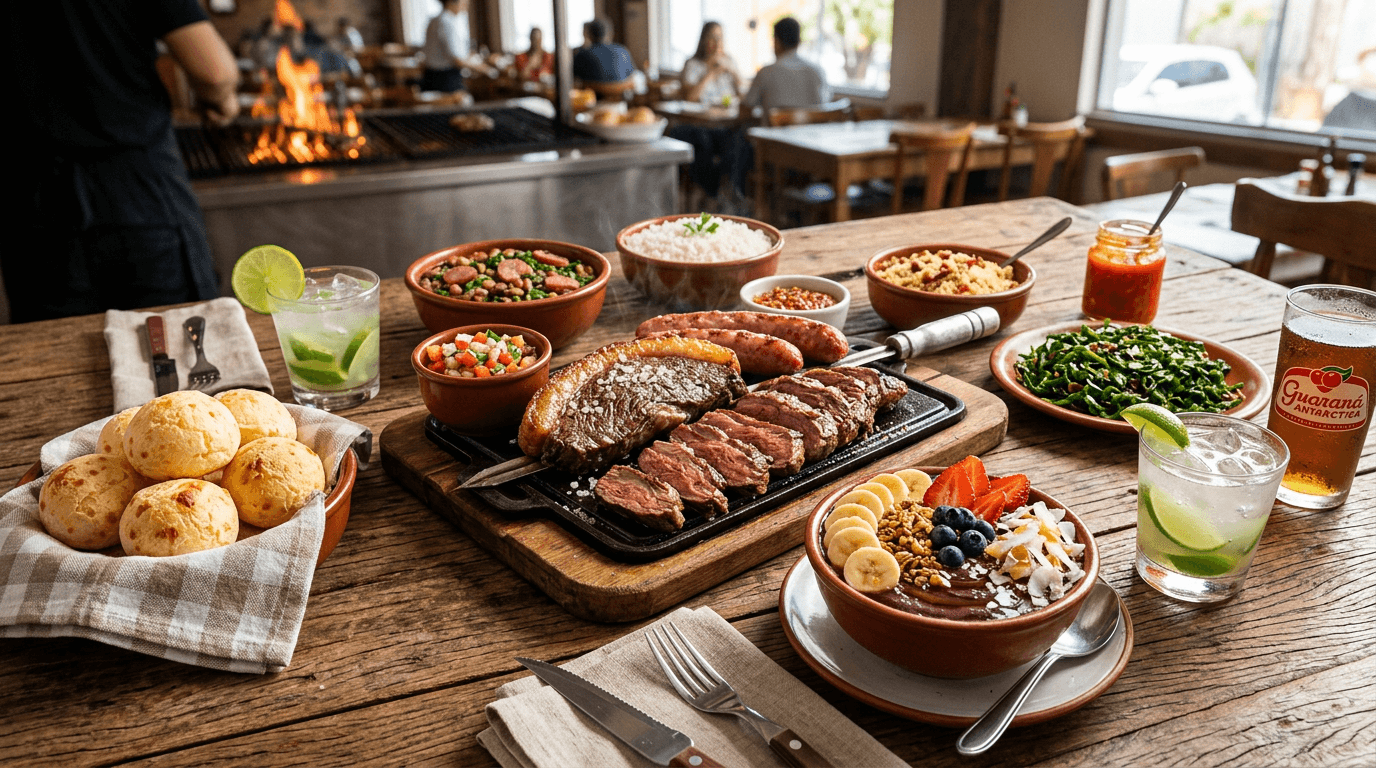
Most people think they know Brazilian food. They've been to a churrascaria in Miami or New York, eaten meat until they couldn't move, and filed Brazil under “barbecue country.” It's a bit like visiting one sushi restaurant and deciding you understand Japanese cuisine.
Brazil is a continent disguised as a country, and its food tells that story better than anything else. Twenty-six states, each with its own culinary identity. African, Portuguese, Indigenous, Italian, Japanese, and German influences layered on top of one another across five centuries. The distance from the gaucho grills of Rio Grande do Sul to the Amazonian fish stews of Pará is not just geographic — it's an entirely different food universe. And if you travel through Brazil paying attention to what's on the plate, you'll understand the country more deeply than any museum or monument could teach you.
Churrasco: The Real Gaucho Tradition
Let's start with what you think you know. The Brazilian steakhouse — the rodizio, with its parade of sword-wielding servers bringing cut after cut of grilled meat — is real, and it's spectacular. But the chain restaurants abroad barely scratch the surface of churrasco culture.
In the southern states of Rio Grande do Sul, Santa Catarina, and Paraná, churrasco isn't a restaurant concept. It's a weekend ritual. Families and friends gather around a brick pit, the churrasqueira, and spend hours slow-grilling cuts of beef, pork, chicken, and sausage over wood charcoal. The star cut is picanha — the top sirloin cap, seasoned with nothing but coarse salt and fire. When it's done right, the fat renders into a crispy exterior while the inside stays impossibly juicy. You slice it thin against the grain, and it melts.
If you're visiting Porto Alegre or the wine country of Vale dos Vinhedos, seek out a traditional churrascaria gaúcha — not the tourist version, but the kind where locals eat. The sides matter too: vinagrete (a fresh tomato and onion salsa), farofa (toasted cassava flour with garlic and butter), and arroz carreteiro (a rice dish loaded with charque, dried beef). This is comfort food that was born on the cattle plains, and it tastes like it belongs there.
Feijoada: The Soul of Brazilian Cooking
Every Brazilian will tell you that feijoada is the national dish, and every Brazilian has an opinion about whose version is the best. At its core, it's a slow-cooked stew of black beans with various cuts of pork — sausage, ribs, ears, tail, sometimes dried beef. It sounds heavy because it is. This is a dish born from necessity, with roots in the food of enslaved Africans who made something magnificent from the cuts of meat that plantation owners discarded.
Feijoada is traditionally a Saturday lunch affair. In Rio de Janeiro, restaurants across the city prepare their version every weekend, served with white rice, farofa, couve (sautéed collard greens), orange slices (they cut the richness brilliantly), and a cold caipirinha on the side. It's communal, unhurried, and unapologetically indulgent. At Casa da Feijoada in Ipanema, they serve it every day of the week — which purists might scoff at, but the quality is undeniable. For a more refined take, the Saturday feijoada at Confeitaria Colombo in downtown Rio, a stunning Belle Époque café that's been open since 1894, is an experience that feeds your eyes as much as your stomach.
In Brazil, food is never just food. It's history on a plate.
Bahian Cuisine: Where Africa Meets the Atlantic
Travel northeast to Bahia and the food changes completely. This is the heart of Afro-Brazilian culture, and the cuisine reflects centuries of West African influence blended with tropical ingredients and Portuguese technique. If southern Brazil is about fire and beef, Bahia is about coconut milk, dendê palm oil, and seafood.
Moqueca is the dish that defines Bahian cooking. It's a fish or shrimp stew cooked in a clay pot with coconut milk, tomatoes, onions, cilantro, and dendê oil — that deep orange-red palm oil that gives Bahian food its distinctive color and nutty, slightly sweet flavor. Moqueca is served bubbling hot, and you eat it with rice and pirão (a thick porridge made from the cooking liquid and cassava flour). In Salvador, virtually every neighborhood restaurant has a version, but the most iconic spot is arguably Yemanjá, right along the water in the Rio Vermelho neighborhood.
Then there's acarajé — Brazil's most famous street food and a direct descendant of West African akara. It's a ball of black-eyed pea dough, deep-fried in dendê oil, split open, and stuffed with vatapá (a creamy shrimp paste), caruru (an okra stew), and spicy shrimp. You buy it from baianas — women in traditional white dresses who set up stands on street corners throughout Salvador. The best ones have lines. Get in them.
Açaí: Forget Everything You Think You Know
If you've only had açaí from a smoothie chain, you have not had açaí. I say this with the authority of someone who tried the real thing in Belém and realized the American version is essentially a different product.
In the Amazon region — particularly in the state of Pará, where açaí is harvested from towering palm trees along the river — it's not a health food. It's a staple food. Families eat it with nearly every meal. The berries are processed the same day they're picked, pounded into a thick, dark purple pulp that's earthy, slightly bitter, and only faintly sweet. It's served in a bowl, sometimes with a sprinkle of sugar and tapioca granules, and eaten alongside fried fish or shrimp. Yes, with savory food. Not with granola and banana slices.
The sweetened, fruit-topped version that you know from Rio and São Paulo is its own thing — delicious, refreshing, and perfect for a beach day. But going to Belém and eating açaí in its purest form, at the Ver-o-Peso market where vendors scoop it fresh from enormous basins, is one of those food experiences that permanently recalibrates your understanding of an ingredient.
The Street Food You Can't Miss
Brazil's street food might be the most underrated in the world. Every city, every neighborhood, has its snack culture, and the quality is remarkably high. Here are the essentials:
- Coxinha: A tear-shaped, breaded, deep-fried ball of shredded chicken in a creamy dough. It's Brazil's answer to the croquette, and when the outside shatters and the inside is still creamy, it's one of the most satisfying bites in the world.
- Pão de queijo: Cheese bread made from tapioca flour, which makes it naturally gluten-free, chewy on the inside, and crispy on the outside. Minas Gerais claims ownership, but you'll find them everywhere. Warm from the oven, they're addictive.
- Pastéis: Thin, crispy fried pastries stuffed with everything from ground beef to hearts of palm to catupiry cheese. The best ones come from the Mercado Municipal in São Paulo, where the pastéis are the size of your head and eaten standing up at the counter.
- Tapioca crepes: In the northeast, street vendors press hydrated tapioca flour onto a hot griddle, fill it with coconut, cheese, condensed milk, or savory options, and fold it into a soft, chewy crepe. Simple and perfect.
- Espetinhos: Grilled meat skewers sold at street stands, particularly at night markets and beaches. Chicken hearts (coração de frango) are the classic choice, and they're better than they sound.
Cachaça, Caipirinhas, and Drinking Culture
You cannot talk about Brazilian food without talking about cachaça — the sugarcane spirit that is to Brazil what tequila is to Mexico or whisky is to Scotland. Most visitors know it only through the caipirinha (cachaça muddled with lime and sugar), and while a well-made caipirinha is genuinely one of the world's great cocktails, the spirit itself goes much deeper.
Artisanal cachaça — aged in native Brazilian woods like amburana, balsam, or jequitibá — is a sipping spirit of remarkable complexity. The state of Minas Gerais is the heartland of production, with small family distilleries (called alambiques) scattered across the countryside. Visiting one of these and tasting aged cachaça straight from the barrel is a revelation. The flavors range from vanilla and cinnamon to tropical fruit and honey, depending on the wood.
In cities like São Paulo and Rio, craft cocktail bars have taken cachaça in exciting new directions. Spots like SubAstor and Guilhotina in São Paulo treat the spirit with the same reverence a Tokyo bar gives Japanese whisky.
São Paulo: A World-Class Food City Hiding in Plain Sight
Here's a bold claim: São Paulo is one of the five best food cities on the planet. It doesn't get the press that Tokyo, Paris, or New York get, but the depth and diversity of dining in this city is staggering.
Start with the immigrant neighborhoods. Liberdade is the Japanese quarter — home to the largest Japanese diaspora outside Japan — and the ramen, sushi, and izakaya food here is extraordinary. Bixiga is the Italian neighborhood where Sunday pasta traditions have survived for generations. Bom Retiro has some of the best Korean food in the Southern Hemisphere.
Then there's the fine dining. D.O.M., Alex Atala's iconic restaurant, put Brazilian ingredients on the global gastronomic map by using Amazonian ants, tucupi broth, and priprioca root in haute cuisine. A Casa do Porco, consistently ranked among the world's best restaurants, serves a pork-focused tasting menu that would convert a vegetarian. Mañi, by chef Helena Rizzo, highlights Brazil's biodiversity with ingredients sourced from Indigenous communities. These aren't just good restaurants — they're statements about Brazilian identity.
And the markets. The Mercado Municipal (“Mercadão”) is essential — a stunning 1930s building overflowing with tropical fruits you've never seen, wheels of cheese, hanging sausages, and the famous mortadella sandwich that is absurdly oversized and absurdly good. Come hungry.
Food Experiences I Recommend for Travelers
If you're planning a trip to Brazil and want food to be a central thread, here's what I build into itineraries:
- Market tours with a local food guide in São Paulo or Salvador. Walking through a market with someone who can explain what you're seeing, tasting, and smelling turns a visit into an education.
- Bahian cooking classes in Salvador. Learning to make moqueca and acarajé from a Bahian cook in her home kitchen is one of those travel memories that stays vivid for years.
- A cachaça distillery visit in Minas Gerais, combined with the incredible colonial towns of Ouro Preto and Tiradentes (which also happens to have a phenomenal food scene).
- A private dinner at a farm-to-table restaurant in the countryside. Brazil's farm-to-table movement is booming, particularly in regions like the Serra Gaúcha and the Chapada dos Veadeiros.
- Street food crawls in Rio or Belém. Forget the Michelin stars for a night and eat where the city eats — at counters, on corners, standing up.
More Than Barbecue
I started with a provocation: that reducing Brazilian food to churrascaria culture is like reducing Japan to sushi. If you've read this far, I hope you see why. From the African-rooted stews of Bahia to the untouched açaí of the Amazon, from the immigrant kitchens of São Paulo to the gaucho fire pits of the south, Brazil's food is a map of its people, its history, and its soul.
And the best way to experience it? Go there hungry. Go with a plan that puts food at the center. Go with someone who knows where to find the things you won't read about in a guidebook.
If Brazil is on your radar — or if reading this just put it there — I'd love to design a trip that eats its way through the country. Every itinerary I build for Brazil has food woven into its DNA, because in Brazil, the table is where everything happens.