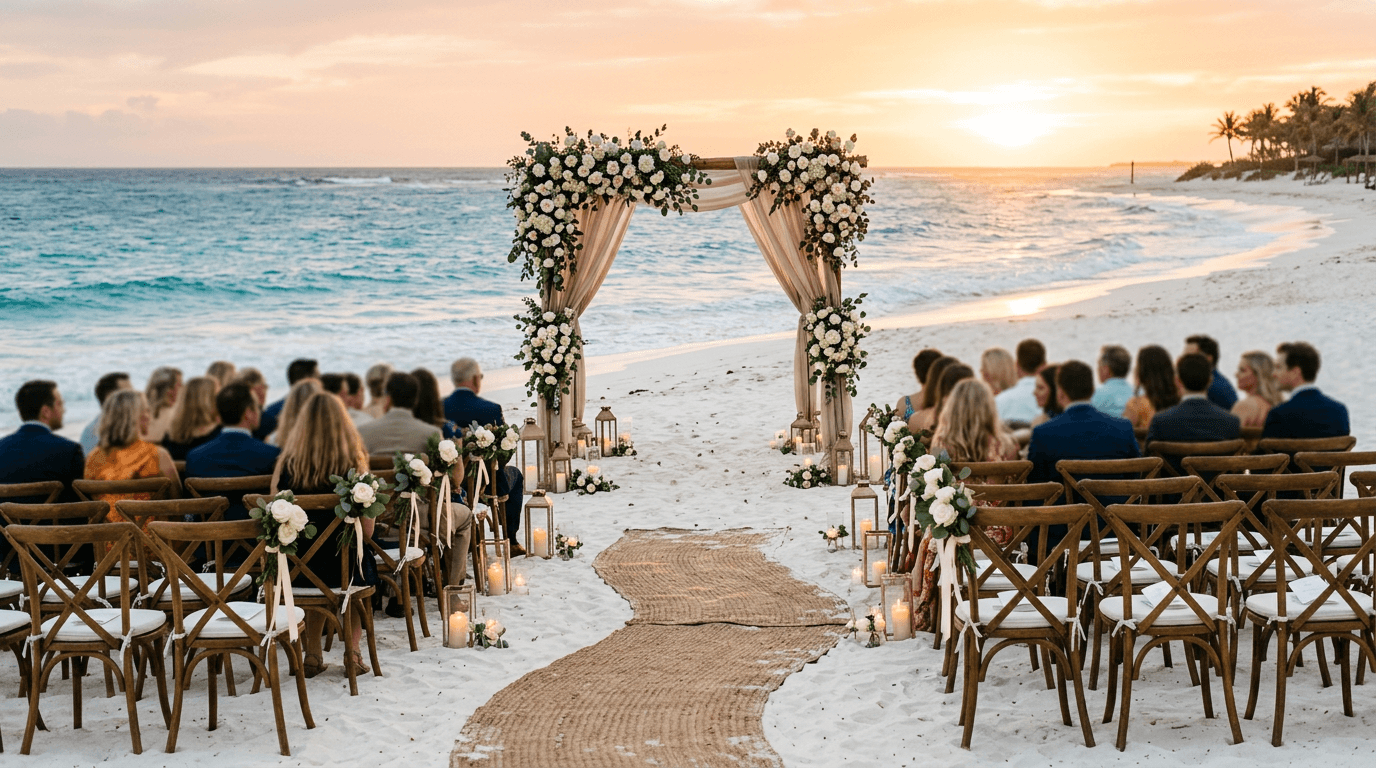
The average Canadian wedding now costs over $40,000. That number lands differently when you realize you could fly 40 of your favourite people to Mexico, host a three-day celebration at a luxury beachfront resort, cover the ceremony, the reception dinner, the flowers — and still come in under that figure. With a vacation attached.
Destination weddings used to feel like a bold, unconventional choice. Now they're one of the fastest-growing segments in the wedding industry, and not just because of Instagram. The math works. The experience is better. And the guest list problem? It solves itself.
The Financial Case Is Stronger Than You Think
Let's talk real numbers. A traditional wedding in Toronto or Vancouver — venue rental, catering for 150 guests, photographer, DJ, flowers, dress, suits, hair and makeup, invitations, favours — adds up fast. The national average sits around $42,000, and in major cities it's not uncommon to push $60,000 or more.
A destination wedding at an upscale resort in Mexico or the Caribbean? The couple's costs for the ceremony, reception, and their own accommodations typically run $15,000–$25,000. Some resort wedding packages start under $5,000 for the event itself. Yes, you read that right.
The savings come from a few places. Venues are included or heavily discounted when you book a room block. Catering costs are lower in most destination markets. And most importantly, your guest count drops naturally — which is the single biggest cost driver in any wedding. Fewer guests means fewer meals, fewer place settings, fewer centrepieces, and a more intimate celebration.
The Built-In Guest Filter
Can we be honest about something? One of the most stressful parts of wedding planning is the guest list. Your parents want their friends there. Your partner's aunt is offended if she's not invited. You have coworkers you'd feel weird not including. Suddenly your intimate celebration has 180 people, half of whom you'll barely speak to on the day.
A destination wedding elegantly eliminates this problem. You invite everyone. The ones who truly want to celebrate with you will make the trip. The obligation invites politely decline. Nobody is offended — “we couldn't make it work with travel” is the most graceful exit in the history of wedding RSVPs.
What you end up with is 30–60 people who genuinely love you, all in one beautiful place, for multiple days. That's not a compromise. That's the dream.
It's Not a Day. It's a Multi-Day Celebration.
This is the part that couples underestimate until they experience it. A traditional wedding is one day — a beautiful, chaotic, emotional blur that's over before you've had a chance to actually talk to half your guests. You spend months planning six hours.
A destination wedding stretches the celebration across three, four, sometimes five days. There's a welcome dinner the night everyone arrives. There's a pool day where your college friends meet your partner's family for the first time over cocktails. There's the ceremony itself. There's a farewell brunch. And in between, there are the unplanned moments — your dad and your best friend playing volleyball on the beach, your grandmother watching the sunset from the terrace, your friends staying up until 2 a.m. at the swim-up bar.
Those are the memories that last. Not the centrepieces.
And for your guests, it's not just a wedding — it's a vacation. Many of them will extend their stay. Parents turn it into a week away. Friends plan side trips. The wedding becomes the catalyst for experiences that everyone carries with them.
Where to Do It: Top Destinations
The right destination depends on your style, your budget, and how far you want your guests to travel. Here are the options I recommend most often:
Mexico (Riviera Maya, Los Cabos, Puerto Vallarta)
Mexico is the most popular destination wedding market for Canadians, and for good reason. Flights are short and affordable, the resort infrastructure is excellent, and the all-inclusive model makes budgeting straightforward. The Riviera Maya offers the lush tropical backdrop — think beachfront ceremonies with jungle behind you. Los Cabos brings desert-meets-ocean drama. Properties like Secrets Moxché Playa del Carmen and Grand Velas Los Cabos have dedicated wedding coordination teams that handle every detail on-site.
Jamaica and the Dominican Republic
Both offer incredible value. Jamaica's Sandals and Beaches resorts pioneered the all-inclusive destination wedding, and their packages are still among the most comprehensive — couples who book enough room nights often get the entire wedding ceremony free. The DR's Punta Cana coast delivers long white beaches and a slightly lower price point that guests will appreciate.
Italy (Amalfi Coast, Tuscany, Lake Como)
For couples who want something elevated and aren't constrained by budget, Italy is unmatched. A villa wedding overlooking Lake Como or a ceremony in a Tuscan courtyard has a romance that's hard to replicate. The food is the reception. The scenery is the decor. It costs more and requires more planning, but the result is cinematic. Properties like Belmond Hotel Caruso on the Amalfi Coast specialize in exactly this kind of event.
Portugal (Algarve, Lisbon, Sintra)
Portugal has quietly become one of the hottest wedding destinations in Europe. It's more affordable than Italy or the south of France, the weather is reliable from May through October, the wine is extraordinary, and the architecture — especially in Sintra's palace estates — is breathtaking. It's still under the radar enough that you won't feel like you're sharing your venue with three other weddings that week.
Resort Packages vs. Custom Planning
Most resorts in Mexico and the Caribbean offer structured wedding packages. These typically include the ceremony setup (arch, chairs, aisle decor), an officiant, a bouquet and boutonniere, a small cake, a cocktail hour, and a reception dinner for your group. Packages range from $3,000 to $15,000 depending on the resort and the level of customization.
The advantage of a resort package is simplicity. The wedding team on-site handles the logistics, you make choices from a curated menu of options, and the coordination is built into the price. For couples who want a beautiful celebration without micromanaging every vendor, this is the way to go.
Custom planning — hiring a destination wedding planner and sourcing your own vendors — gives you more creative control but adds complexity and cost. This makes sense for European weddings, villa rentals, or couples with a very specific vision. The key is knowing which approach matches your priorities before you start spending.
Group Booking: Where a Travel Advisor Earns Their Weight in Gold
Here's where most couples massively underestimate the workload. You're not just planning a wedding — you're coordinating travel for 20 to 60 people with different budgets, different schedules, different room preferences, and different levels of travel competence.
Do you want to be the person fielding texts from your partner's uncle about whether his room has a king bed? Or explaining to your college roommate that the resort does, in fact, accept Canadian credit cards? No. You do not.
When I manage a destination wedding, I handle all guest bookings individually. Every guest gets personal service — their own room preferences, their own travel questions answered, their own payment schedule. The couple doesn't become the travel agent for their own wedding. This alone is worth the price of admission.
Beyond the logistics, group bookings unlock real financial benefits:
- Negotiated group rates — resorts offer discounted room rates for wedding blocks, often 15–30% below rack rate
- Complimentary rooms for the couple — many resorts offer free nights for the bride and groom when a minimum room block is met
- Private events included — welcome cocktail parties, rehearsal dinners, or farewell brunches are often thrown in with larger groups
- Room upgrades — the couple and sometimes the parents are upgraded to suites at no extra cost
- Reduced or waived wedding package fees — the more rooms booked, the more the resort invests in your event
To give you a sense of scale: a typical 40–50 guest wedding group in the Riviera Maya can save guests $150–$200 per person on room rates compared to individual bookings. The couple often receives three to five complimentary nights, a room upgrade to a premium suite category, and a free private welcome event for the group. None of that happens without a group block managed by an advisor.
What Couples Get Wrong
After helping plan dozens of destination weddings, I've seen the same mistakes come up repeatedly. Here are the big ones:
Choosing the destination before thinking about guests. You might love Bali, but if most of your guests are in their 60s and 70s, a 20-hour flight with two connections is a non-starter. The destination needs to work for the people you most want there. A three-hour direct flight from Toronto to Cancun is a very different ask than 12 hours to Portugal.
Booking too late. Popular resorts in peak wedding season (November through April for beach destinations) can book out 12–18 months in advance for prime ceremony times. The Saturday sunset slot at your dream resort? Someone booked it a year ago. I recommend starting the process at least 14–18 months before your ideal date.
Not considering the legal requirements. Getting legally married varies by country. In Mexico, the paperwork is manageable but requires advance preparation. In some Caribbean countries, there's a residency requirement. Many couples simplify this by doing a legal ceremony at home (a quick courthouse visit) and treating the destination event as the celebration. It's common, it's practical, and it takes the bureaucratic stress off the trip entirely.
Trying to DIY the group coordination. I can't stress this enough. Managing 30+ bookings with different travel dates, budgets, and preferences while also planning a wedding will wear you down. It's the number one source of pre-wedding stress I see in destination wedding couples who come to me after trying to handle it themselves.
It's About the Celebration, Not Just the Ceremony
Remember that $40,000+ average for a traditional Canadian wedding? Now think about what you actually remember from the last hometown wedding you attended. Probably not the linens. Probably not the favour bags. You remember the toast that made you cry. The dance floor at midnight. The conversation you had with someone you hadn't seen in years.
A destination wedding strips away the noise and amplifies the things that matter. Fewer guests means more time with each person. A stunning natural setting means less need for expensive decor. And spreading the celebration across several days means you actually get to enjoy your own wedding — not just survive it.
The best wedding I ever attended wasn't the most expensive one. It was the one where 35 people who truly loved the couple spent four days together in paradise.
If you're engaged — or even just thinking about it — and a destination wedding has crossed your mind, let's talk. I can walk you through options that match your vision, your budget, and the people you want by your side. No pressure, no sales pitch. Just a conversation about how to celebrate the start of your life together in a place that makes the whole thing unforgettable.