Picture two European trips with identical wish lists: great wine, walkable old towns, no airports between stops. One is a two-week land itinerary through France — rental cars, hotel check-ins, train schedules, luggage logistics. The other is a 10-day Danube river cruise. Both deliver an incredible experience. But the river cruise covers five countries, requires unpacking exactly once, and typically costs 20–30% less. It also happens to be one of the most relaxed ways to travel that exists.
River cruising isn't just growing in popularity. It's converting people who swore they'd never cruise.
The Format That Fixes What People Hate About Cruising
Ask someone why they don't like ocean cruising and you'll hear the same complaints: too many people, too many days at sea staring at water, too much time on a ship, not enough time in the destination. River cruising eliminates every single one of these objections.
The ships are small — typically 150 to 190 guests, compared to 3,000–6,000 on a modern ocean liner. There are no sea days because there is no sea. The ship moves overnight while you sleep, and you wake up docked in the heart of a new city, often steps from the main square. No tender boats. No taxi from a remote port terminal. You walk off the ship and you're there.
This is the single biggest draw, and it genuinely changes how you travel.
Wake Up in a New City. Every Morning.
Imagine opening your curtains in Vienna, spending the day exploring palaces and coffee houses, returning to the ship for dinner, and waking up in Bratislava. The next morning, Budapest. No checking out. No dragging luggage through train stations. No navigating airport security between cities. Your hotel follows you, and you never miss a moment of the destination.
This is why river cruises appeal so strongly to travelers who love independent exploration but are tired of the logistics. The ship handles all the moving parts. You just show up to each new place.
And because river ships dock centrally, your shore time is maximized. On an ocean cruise, a port call might give you six hours — minus 45 minutes each way in a shuttle from the cruise terminal. On a river cruise, you step onto a cobblestone street and your entire day belongs to you. Want to wander back to the ship for lunch and head out again in the afternoon? The gangway is right there.
The Best River Itineraries (And What Makes Each One Special)
Not all rivers are created equal. Each waterway has a personality, and the right choice depends on what kind of trip excites you.
The Danube is the classic entry point, and for good reason. A sailing from Budapest to Nuremberg (or the reverse) passes through Austria, Slovakia, and Germany, with stops in Vienna, Melk, Passau, and Regensburg. It's ideal for first-time river cruisers — the ports are stunning, the infrastructure is polished, and Christmas market sailings in November and December are genuinely magical. Snow-dusted medieval towns, mulled wine by the river, wooden stalls glowing with handmade ornaments. It's the European winter experience most people dream about but struggle to plan on their own.
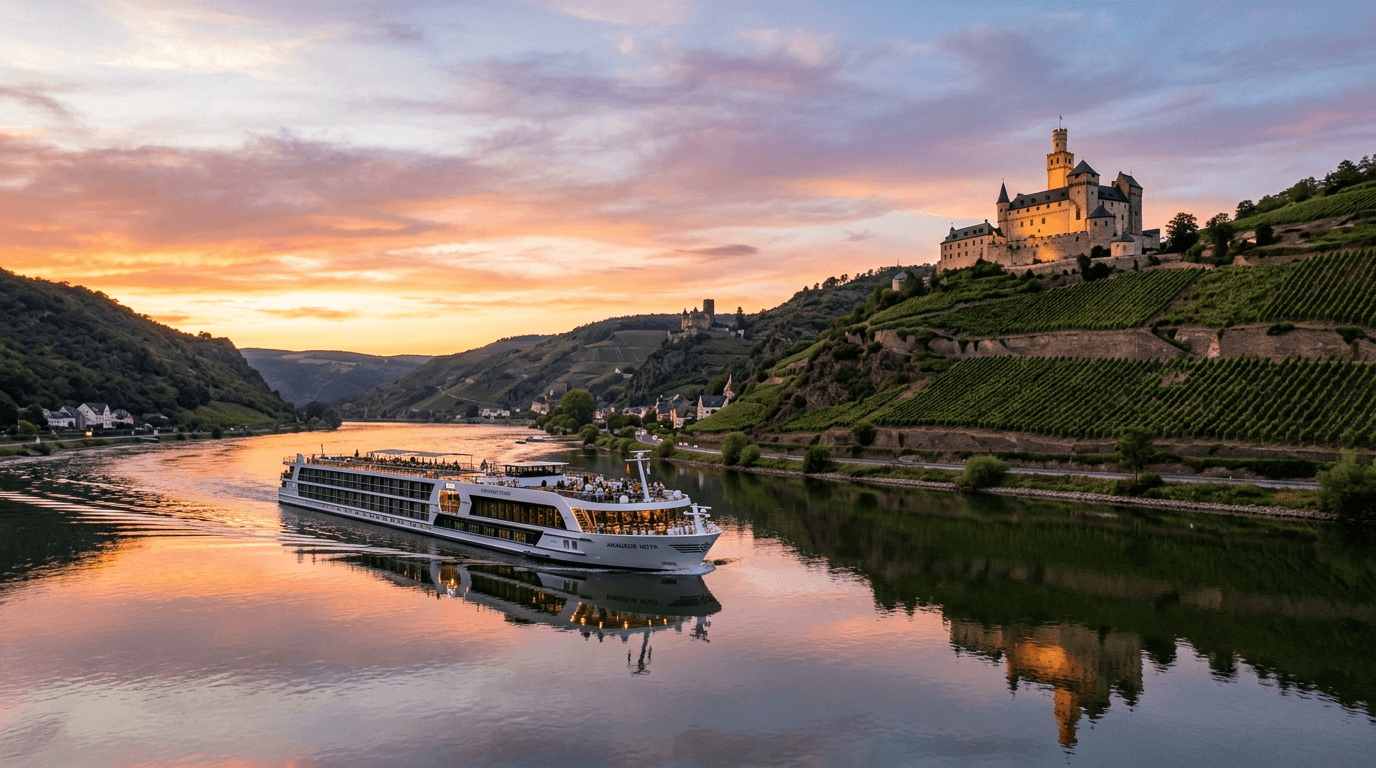
The Rhine delivers the storybook version of Europe. Castles perched on hilltops, terraced vineyards dropping to the water's edge, medieval villages that look like they haven't changed in 400 years. The stretch between Basel and Amsterdam is the most popular route, with highlights like Strasbourg, Heidelberg, Cologne, and Kinderdijk's windmills. If you love wine, architecture, and history in equal measure, this is your river.
The Douro in Portugal is the one I recommend to travelers who've already done the Danube and Rhine. It's quieter, less traveled, and visually dramatic — terraced port wine vineyards cascading down steep hillsides, small towns where locals still hang laundry from wrought-iron balconies, and some of the best food and wine in Europe at a fraction of French prices. A Douro cruise pairs beautifully with a few days in Lisbon or Porto on either end.
The Douro is one of Europe's best-kept secrets — but not for much longer.
The Mekong takes river cruising into entirely different territory. Sailings between Ho Chi Minh City and Siem Reap (Angkor Wat) pass through the Vietnamese and Cambodian countryside in a way that no bus tour or flight can replicate. Floating markets, Buddhist temples, rural villages where children wave from the riverbank. It's immersive, emotional, and unlike anything in Europe. If Southeast Asia is on your radar, this is the way to experience it.
The Nile remains iconic for a reason. A sailing from Luxor to Aswan passes the Valley of the Kings, Karnak Temple, and Edfu — monuments that are staggering in person regardless of how many photos you've seen. Pair it with a few days in Cairo and you have one of the world's great cultural journeys.
Which Lines Stand Out (And Why It Matters)
River cruise lines vary more than you'd expect. The ships are all roughly the same size (European rivers have lock and bridge restrictions that cap dimensions), so the differences come down to service philosophy, cuisine, excursion quality, and onboard atmosphere.
AmaWaterways is the line I recommend most frequently. Their ships feel boutique but not stuffy — think premium hotel, not museum. The dining is outstanding (they were the first river line to partner with a culinary institution, and it shows), the excursion options include hiking and cycling for active travelers, and their service hits the sweet spot of attentive without hovering. For Canadian travelers especially, Ama delivers exceptional value at the luxury tier.
Uniworld is the choice for travelers who want the ship itself to be part of the experience. Each vessel is individually designed — ornate, art-filled, and dripping with personality. The S.S. La Venezia, for example, is a floating tribute to Venetian artistry, with hand-blown Murano glass chandeliers and original artwork in every suite. If design and aesthetics matter to you as much as the destination, Uniworld is unmatched.
Viking dominates the river cruise market by volume, and they do a lot of things well — clean Scandinavian design, strong cultural programming, and competitive pricing. They're an excellent option for travelers who want a polished, well-organized experience without the ultra-premium price tag. Where they differ from Ama and Uniworld is in the all-inclusive structure (some beverages and excursions are add-ons) and a slightly larger guest count.
Does the line choice matter? Absolutely. I've seen the same Danube itinerary feel completely different on two different ships. The route is identical. The experience is not.
Who Should Consider a River Cruise?
River cruising tends to attract a slightly different traveler than ocean cruising, and understanding the overlap helps set expectations.
You're a “land person” who wants less planning. If you love independent European travel but the logistics of trains, rental cars, and hotel check-ins have started to wear on you, a river cruise gives you the best of both worlds. Destination immersion with zero transit headaches.
You're a couple or a group of friends. The intimate scale of river cruising (everyone eats dinner at the same time, the lounge seats feel like a living room) creates a social atmosphere that's hard to replicate on a 3,000-person ship. River cruise guests regularly make genuine friendships in a way that rarely happens on larger ships.
You're celebrating something. Milestone birthdays, anniversaries, retirements — river cruises are perfect for these because every day brings a new backdrop. Toast your anniversary in Vienna. Celebrate with a wine tasting in the Wachau Valley. There's a natural rhythm of discovery that makes every day feel special without any effort on your part.
You care about food and wine. River cruise dining has become genuinely impressive. Regional menus that reflect where the ship is docked that day. Local wine pairings at dinner. Cooking demonstrations. Market visits in port. If food is central to how you experience a destination, river cruising delivers this naturally.
A Few Things to Know Before You Book
River cruising isn't for everyone, and I'd rather you know that upfront than discover it mid-trip.
The ships are smaller, which means fewer onboard amenities than an ocean liner. There's no casino, no Broadway show, no rock-climbing wall. The entertainment is the destination itself. If you want a ship with endless onboard activities, ocean cruising or a resort might be a better fit.
Cabin sizes are compact compared to luxury ocean suites. European river ships are constrained by lock widths (11.45 metres across, to be exact), so even the best cabins are cozy. You won't have a sprawling terrace. You will have a French balcony or a full balcony depending on the category, and the design teams make smart use of every square foot — but if space is your top priority, manage expectations.
Water levels matter. Drought conditions or flooding can occasionally alter itineraries. This happens rarely, and the lines handle it well (usually swapping to motorcoach transfers between ports), but it's worth understanding. The best time to minimize this risk varies by river — another reason working with an advisor pays off.
Why an Advisor Makes the Difference
Think back to that comparison at the start — the land itinerary versus the river cruise. Both are wonderful ways to see Europe. But one requires weeks of logistics planning: trains, car rentals, hotel research, restaurant reservations in four cities. The other requires choosing an itinerary and a cabin. Same quality of experience. A fraction of the planning effort.
Beyond convenience, I can match you with the right line and the right sailing based on details that don't show up on a website — which ships were recently renovated, which itineraries have the best timing for festivals or harvest season, which cabin categories offer the best value. As a Virtuoso advisor, I also secure perks like onboard credits and special touches that make the experience feel even more personal.
If you've been thinking about a river cruise — or if you've been writing off cruising altogether — I'd love to show you what's possible. There's a river, a route, and a ship out there that fits exactly what you're looking for. Let's find it together.